The Iran Hostage Crisis: Diplomatic Drama and Legal Innovation
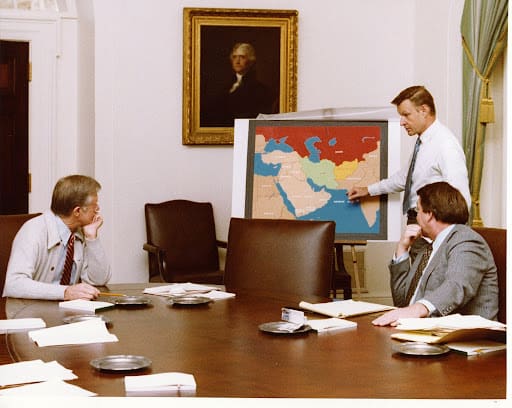
National Security Advisor Zbigniew Brzezinski pointing toward a map of Iran and countries in its vicinity during a meeting with President Carter and Frank Moore to brief them about the Iran hostage crisis on January 4, 1980
Next to Pearl Harbor and 9/11, the Iranian seizure of the U.S. Embassy in Tehran on November 4, 1979 and the detention of fifty-two American diplomats for 444 days constituted the most consequential foreign attack on the United States in modern American history. Mark Feldman’s oral history provides a riveting account of the fraught diplomacy that finally freed the hostages as well as the novel legal work that protected the financial interests of American banks, investors, and contractors.
National Security Advisor Zbigniew Brzezinski pointing toward a map of Iran and countries in its vicinity during a meeting with President Carter and Frank Moore to brief them about the Iran hostage crisis on January 4, 1980
As a deputy legal adviser in the State Department, Feldman was deeply involved in managing the legal issues arising from U.S. sanctions against Iran and the main drafter of the critical claims agreement with Iran. As acting legal adviser in the first months of the Reagan administration, he had a lead role in implementing the Algiers Accords.
Iran refused to engage with the Carter administration until September 1980 and waited until the eve of the U.S. presidential election in November to negotiate through the government of Algeria. There were no direct negotiations between Washington and Tehran. As Feldman recounts, Iran tabled a Christmas surprise coupling agreement to arbitrate American claims with a demand for a twenty-four-billion-dollar deposit supposedly covering Iranian assets frozen by the United States and stolen by the former Shah. At this point, President Carter made the decision to ignore impossible demands. An Algerian delegation was summoned to Washington for consultation and Deputy Secretary Warren Christopher led an inter-agency team to Algiers for the duration of Carter’s term.
The Algiers Accords consist of two Declarations issued by Algeria—accepted by the United States and Iran—providing for the release of the hostages, lifting of the Iranian asset freeze, payment of loans to American banks, and creation of an international tribunal (backed by a billion dollar fund) for the settlement of American property and contract claims. The Accords were implemented in the United States by executive orders later upheld by the Supreme Court. To be successful, the Iran Claims Agreement had to deal with complex substantive and procedural issues in a few pages that would protect U.S. interests in a variety of contingencies and that could be understood and accepted by a hostile, revolutionary regime. The final text runs less than four pages.
As Feldman’s oral history describes, however, implementing the Accords required marshaling eight billion dollars of Iranian assets overnight. A team of lawyers worked in the Cabinet room on inaugural eve as bands played for Ronald Reagan outside the windows, and later that night President Carter had to intervene personally to transfer billions from American banks when the telex codes did not work properly. Still, Iran held the hostages’ plane on the ground until President Reagan was inaugurated at noon, January 20, 1981.
Feldman and dozens more attorneys in government and private practice helped policy makers manage the Iran Hostage crisis. Furthermore, Feldman’s oral history demonstrates the immense diversity of the work that lawyers pursue in the Department of State in relation to foreign affairs. It describes his engagement with POWs in Vietnam; the Hijacking agreement with Cuba; Panama Canal treaties; investment disputes in Peru and Chile; the 1970 UNESCO Cultural Property Convention; maritime boundary negotiations with Canada, Mexico, and Cuba; foreign bribery scandals and the FCPA; and the Foreign Sovereign Immunities Act of 1976. This oral history is a must-read for those interested in careers that tie together law, foreign affairs, and public service.
Mark Feldman’s interview was conducted by Robin Matthewman beginning on April 28, 2021.